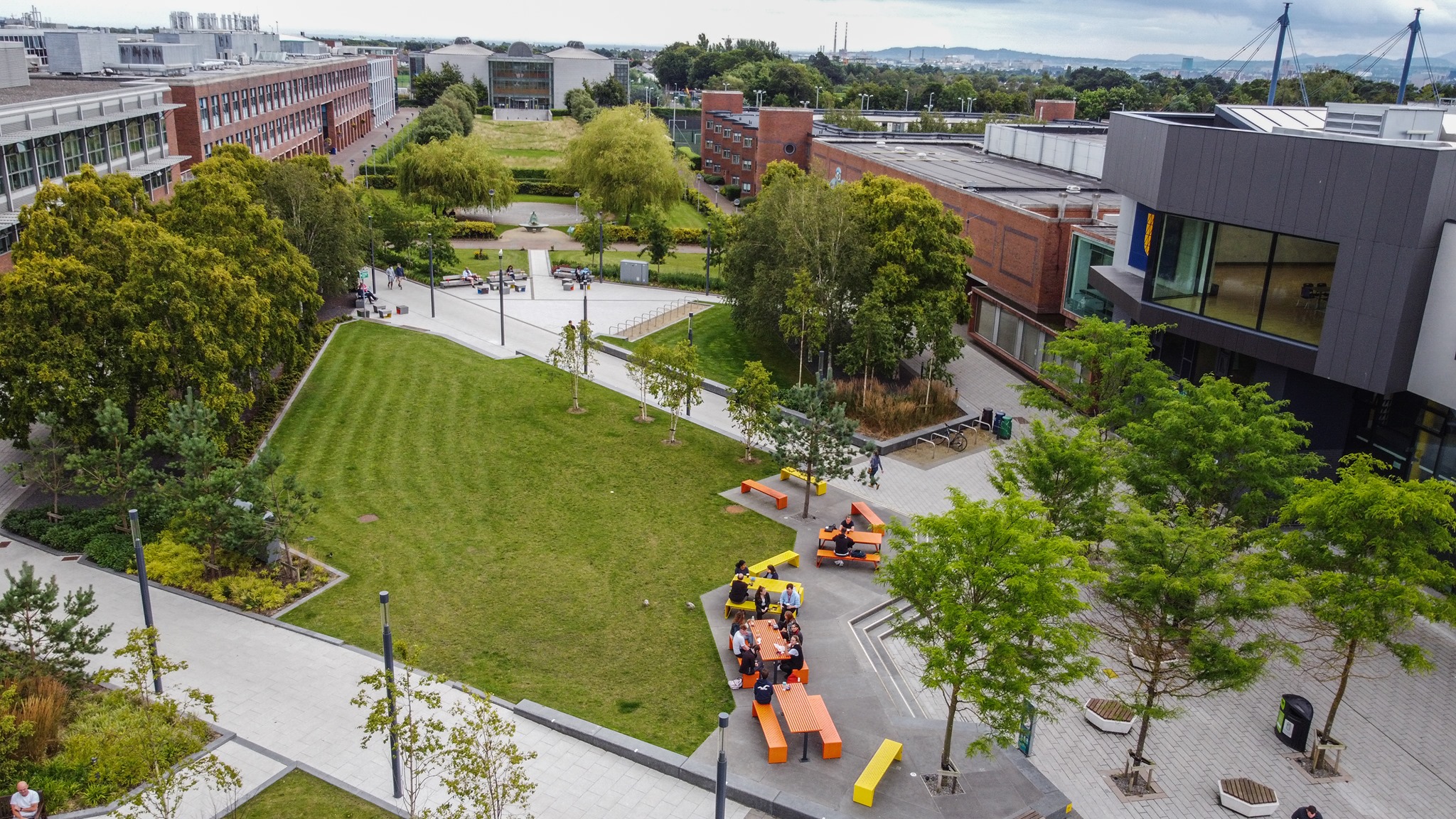
The global landscape of higher education is shifting as new study destinations gain prominence. Undergraduate study in Ireland has gained growing international attention, driven by strong enrolment growth and a reputation for academic quality. Data from the Higher Education Authority shows that 44,500 international students enrolled in Irish institutions in the 2024–25 academic year, marking a record high and signalling strong global confidence.
Within this evolving landscape, Dublin City University (DCU) illustrates how Ireland’s undergraduate model is adapting to the demands of a globally connected economy.
Industry proximity and employability for undergraduate study in Ireland
One of the defining strengths of undergraduate study in Ireland is the close relationship between universities and industry. Government policy actively supports this collaboration. In 2019, the Department of Education introduced strategic initiatives to strengthen STEM education and deepen partnerships between universities and employers. These measures help build a strong talent pipeline.
This alignment contributes to strong employment outcomes. According to national data, 80.2 percent of graduates in Ireland were employed within nine months of graduation in 2024, reflecting a labour market closely aligned with higher education.
How Dublin City University connects students with industry
DCU demonstrates how these industry connections operate in practice by acting as a bridge between the university and industry. The institution maintains strong partnerships with employers and integrates industry engagement into the undergraduate experience.
A key component of this approach is DCU’s INTRA (Integrated Training) programme, which embeds professional experience within degree programmes. Through INTRA, students complete structured, credit-bearing placements that provide practical experience while still at university.
DCU’s location in Dublin further strengthens these opportunities. Students benefit from proximity to the city’s technology hub, often referred to as “Silicon Docks,” as well as Ireland’s major pharmaceutical and life sciences clusters.
Additional initiatives strengthen these industry connections. For example, the STInt programme provides industry immersion opportunities for pre-service teachers, helping them develop a deeper understanding of evolving workplace demands.
Together, these initiatives highlight why undergraduate study in Ireland continues to attract students seeking strong industry connections and career-focused learning.
Research opportunities for undergraduate study in Ireland
Beyond industry partnerships, another defining strength of undergraduate study in Ireland is the emphasis on research-led teaching. Irish universities integrate academic discovery into the learning environment, helping students develop analytical thinking and practical problem-solving skills. Under the Impact 2030 framework, Ireland prioritises research and innovation as central pillars of its higher education system.
Ireland has secured more than €1 billion in funding from Horizon Europe, the European Union’s flagship research and innovation programme. This investment enables universities to expand research opportunities while strengthening inquiry-based learning across disciplines.
How Dublin City University engages undergraduates in research
DCU demonstrates how this research-led model operates in practice by involving undergraduate students in active research environments.
A key initiative is the Undergraduate Summer Research Internship (UGSRI) scheme. Through this programme, students work alongside faculty on live research projects in modern laboratories, gaining exposure to advanced techniques across disciplines such as mechanical engineering and chemical sciences.
Within the School of Chemical Sciences, for example, undergraduates participate in hands-on research that reflects the high-technology environments of the global pharmaceutical industry.
Beyond laboratory work, DCU also fosters inquiry through specialised centres such as the Further Education and Training Research Centre (FETRC). These centres involve undergraduate students in research that informs educational policy and practice.
Together, these initiatives highlight how undergraduate study in Ireland combines rigorous academic learning with meaningful research engagement, allowing students to contribute to new knowledge during their studies.
The EU advantage of undergraduate study in Ireland
Another advantage of undergraduate study in Ireland lies in the country’s position within Europe. As the only English-speaking member of the European Union (EU), Ireland provides students with direct access to a 27-country network of economic and academic opportunities. Qualifications earned in Ireland align with the European Qualifications Framework, ensuring compatibility with higher education systems across Europe.
In addition, the European Credit Transfer and Accumulation System (ECTS) allows academic credits earned in Ireland to transfer seamlessly between universities across EU member states. For students pursuing undergraduate study in Ireland, the ECTS framework simplifies academic mobility. It makes further study, internships and employment in cities such as Berlin, Paris and Amsterdam easier to access.
How Dublin City University enables European academic mobility
DCU expands these opportunities through programmes that allow students to study across multiple European countries during their degree.
One example is DCU’s Dual Degree programmes. In several business and humanities disciplines, students divide their studies between Dublin and partner institutions across Germany, France and Spain. For instance, undergraduates may spend two years at DCU and two years at partner universities such as ESB Reutlingen in Germany. They graduate with two recognised degrees.
As a result, the programmes include professional placements in both countries, allowing students to gain international work experience while completing their studies.
Additionally, DCU strengthens European engagement by participating in the ECIU University alliance, a network of European institutions focused on challenge-based learning. Through this initiative, students can earn micro-credentials by completing short-term interdisciplinary modules that address real-world challenges. In doing so, students build a European professional network without spending a full year abroad.
Together, these opportunities illustrate how undergraduate study in Ireland provides access to a wider European academic and professional ecosystem.
Innovation-led curricula for undergraduate study in Ireland
Ireland’s higher education system increasingly emphasises innovation and interdisciplinary learning. This shift shapes undergraduate study in Ireland through curricula that prioritise problem-solving, collaboration and digital fluency. National initiatives such as the Human Capital Initiative encourage universities to design programmes aligned with emerging economic and technological demands.
Consequently, undergraduate study in Ireland increasingly moves beyond traditional lecture formats. Students engage with real-world challenges, apply theory to practical contexts and work across disciplines. This approach strengthens adaptability alongside subject expertise.
How Dublin City University integrates innovation into undergraduate learning
The university reflects this national shift through the DCU Futures initiative. The initiative introduces new interdisciplinary programmes designed to address contemporary global challenges. For example, programmes include Digital Business and Innovation, Psychology and Disruptive Technologies and Chemistry with Artificial Intelligence. These programmes combine diverse academic fields to emphasise applied learning.
As a result, DCU moves away from static lectures toward innovative pedagogy and assessment. In this model, the curriculum focuses on transversal skills such as data literacy and creative intelligence. Graduates from all undergraduate faculties develop skills suited to roles that do not yet exist.
A key component of this model is Challenge-Based Learning (CBL). Through this approach, students work on real societal and industry problems, often collaborating with organisations and external partners. Whether in the DCU Business School or through advanced pathway courses, the curriculum is designed to be a living lab.
Together, these approaches demonstrate how undergraduate study in Ireland increasingly integrates innovation, interdisciplinary learning and practical problem-solving within the curriculum.
Strong post-study pathways for international students
A key advantage of undergraduate study in Ireland is the structured pathway from education to employment. International graduates can remain in the country through the Third Level Graduate Programme, commonly known as Stamp 1G. Under this scheme, honours bachelor’s graduates (Level 8) may stay in Ireland for 12 months to seek employment. Graduates with postgraduate qualifications (Level 9 or above) may remain for up to 24 months.
For students completing their undergraduate study in Ireland, this transition period allows graduates to gain professional experience. Many graduates move from the Stamp 1G permission to either a Critical Skills Permit or a General Employment Permit, depending on their role and sector.
The Critical Skills Employment Permit applies to occupations on Ireland’s Critical Skills Occupations List. After two years on this permit, graduates may apply for Stamp 4 permission, which allows them to live and work in Ireland without requiring an employment permit.
Alternatively, graduates may obtain a General Employment Permit, which covers most professions not included on the critical skills list. Holders may renew this permit after two years and continue employment for an additional three years. After five years of employment in Ireland, they may also apply for Stamp 4 permission.
For students considering undergraduate study in Ireland, these structured pathways provide clarity on post-study employment and long-term residency options.
How Dublin City University supports career development
DCU helps international students completing undergraduate study in Ireland navigate employment pathways through its dedicated Careers Service.
Students gain access to MyCareer, a digital platform that provides job listings, career resources and appointments with professional advisors. They use the platform to identify opportunities aligned with Ireland’s Critical Skills and General Employment permit pathways.
Furthermore, DCU organises networking events such as the annual Careers Fair, where global employers engage directly with students on campus. These events create opportunities for internships, graduate roles and industry connections.
In addition, the Careers Service provides workshops, CV clinics and personalised guidance. Together, these services help students prepare for employment and strengthen their transition from undergraduate study in Ireland to the professional workforce.
Undergraduate study in Ireland combines industry engagement, research-led learning, alignment with European academic standards, and structured post-study pathways within a coherent higher education system. Strong international enrolment and positive employment outcomes reflect growing global confidence in this model.
Dublin City University illustrates how these strengths translate into practice. Through industry collaboration, research-driven teaching and strong European partnerships, the university reflects the broader evolution of undergraduate study in Ireland while preparing students for global careers.
—————————————————————————————————————————–
About Dublin City University:
Dublin City University is an innovative European university with a mission to transform lives and societies through education, research and collaboration. Ranked among the world’s top 350 universities by Times Higher Education and recognised as Ireland’s No. 1 young university, DCU is known for delivering a transformative student experience while addressing global challenges in partnership with national and international stakeholders.
The university operates across several campuses in Dublin, including Glasnevin, St Patrick’s and All Hallows, and is organised into five faculties: Humanities and Social Sciences, Engineering and Computing, Science and Health, DCU Business School and the Institute of Education. DCU hosts a diverse academic community of more than 15,000 undergraduates, 4,000 postgraduates, over 500 doctoral students and 3,000 staff representing more than 130 nationalities. Its graduates are among the highest earners in Ireland, according to the Central Statistics Office Graduate Income Survey.
For information on admissions and recruitment, contact Shagun Arora:
Email: shagun.arora@dcu.ie | Phone: +91 96677 40024
For assistance with applications, contact The Red Pen Undergraduate Admissions Team.