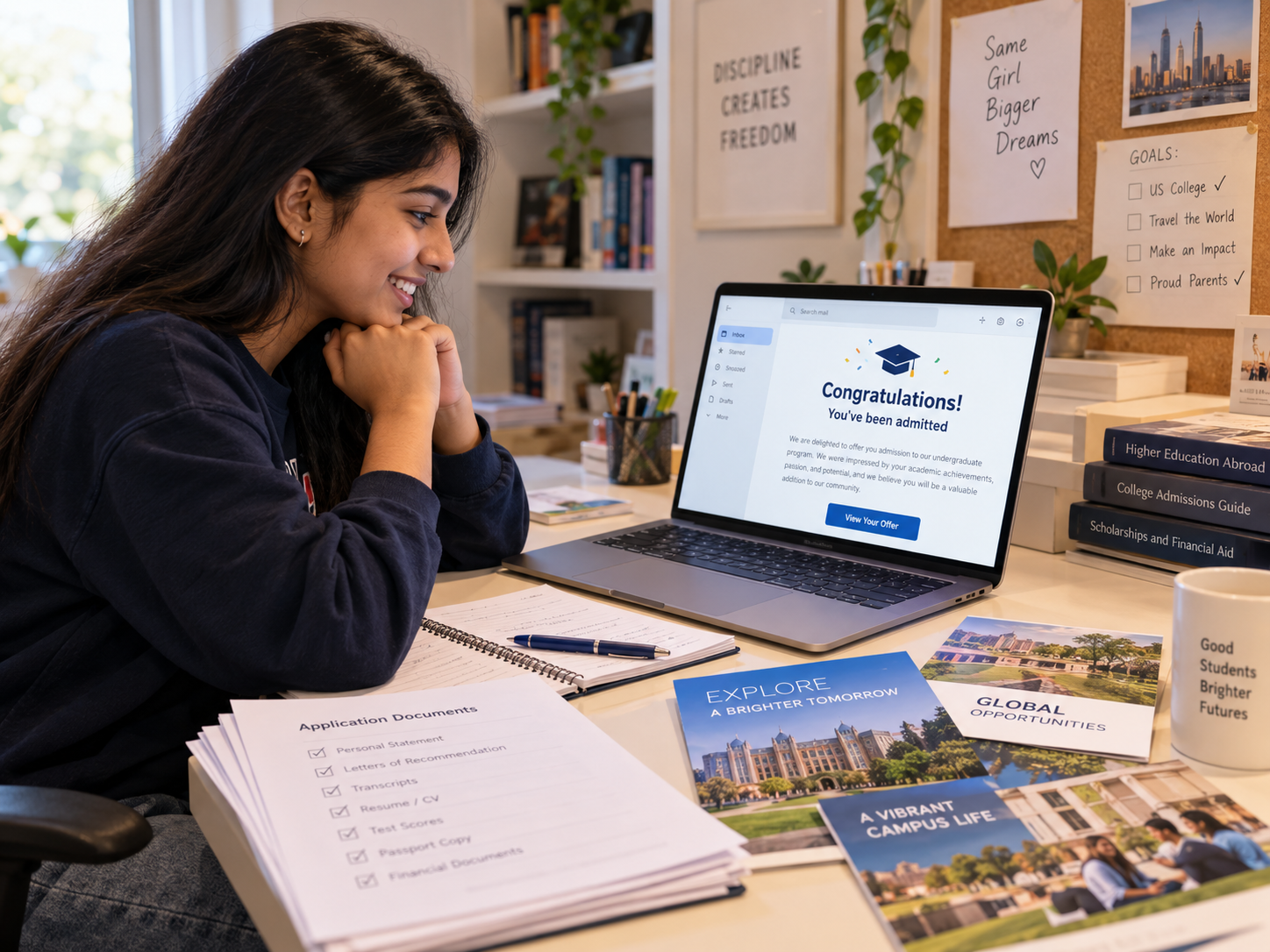
US college offers without applying are becoming possible through new undergraduate admission routes such as Match, Common App Direct Admissions, and U.S. News Direct Admissions. Traditionally, students choose universities, complete applications, and submit the required documents. They then wait for colleges to decide. The numbers show how extensive this process has become. For example, during the 2025-26 admissions cycle,1,527,328 first-year applicants used the Common App for undergraduate admissions in the US. Together, they submitted 10,786,782 applications, averaging just over seven colleges per applicant. However, this traditional admissions model is changing.
How Match helps students get US college offers without applying
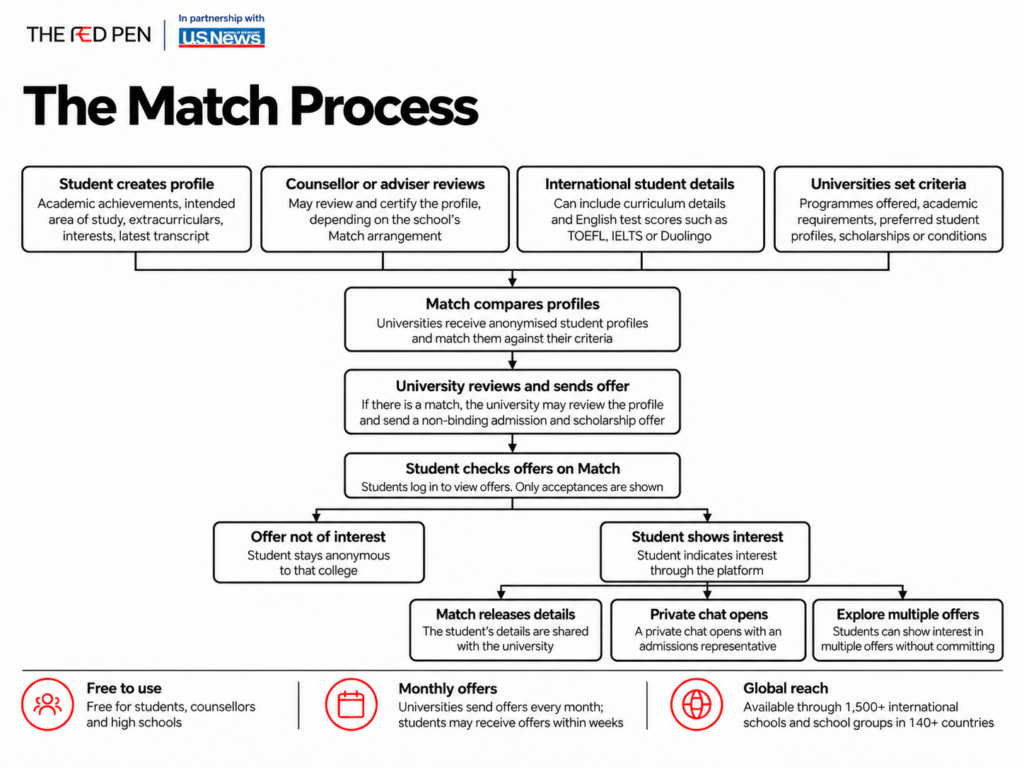
Match, powered by Concourse, is offered through Appily as Appily Match for students in the US and as Global Match for international students. Students create one profile covering their academic achievements, intended area of study and extracurricular accomplishments. They also include their personal and educational interests and upload their latest transcript.
A school counsellor or education adviser may review and certify the profile, depending on the school’s Match arrangement. International students can also include details about their curriculum and report TOEFL, IELTS or Duolingo English Test scores.
Additionally, universities use Match to set their own criteria. They specify the programmes they offer, academic requirements, preferred student profiles and any scholarships or conditions linked to an offer. Universities receive anonymised student profiles and match them against their criteria. If a student’s profile matches a university’s criteria, the university may review the profile and send an offer through the platform. According to EAB (Education Advisory Board), a US-based education consulting and technology company, universities send offers every month. Students can receive non-binding admission and scholarship offers within weeks.
Students check their offers by logging in to Match. The platform only shows acceptances, so students do not see rejections. If an offer interests a student, they can indicate this through the platform.
Match then releases their details to the university and opens a private chat with an admissions representative. Students can show interest in as many offers as they like without committing. If an offer does not appeal, they remain anonymous to that college.
Furthermore, Match is free for students, counsellors and high schools. EAB reports more than 800,000 admission offers and over $37 billion in scholarship offers so far. Global Match reaches students in more than 140 countries through over 1,500 international schools and school groups. For example, the American International School of Cape Town reported that its students received 689 admission offers through Match in a single year.
How Common App Direct Admissions helps students get US college offers without applying
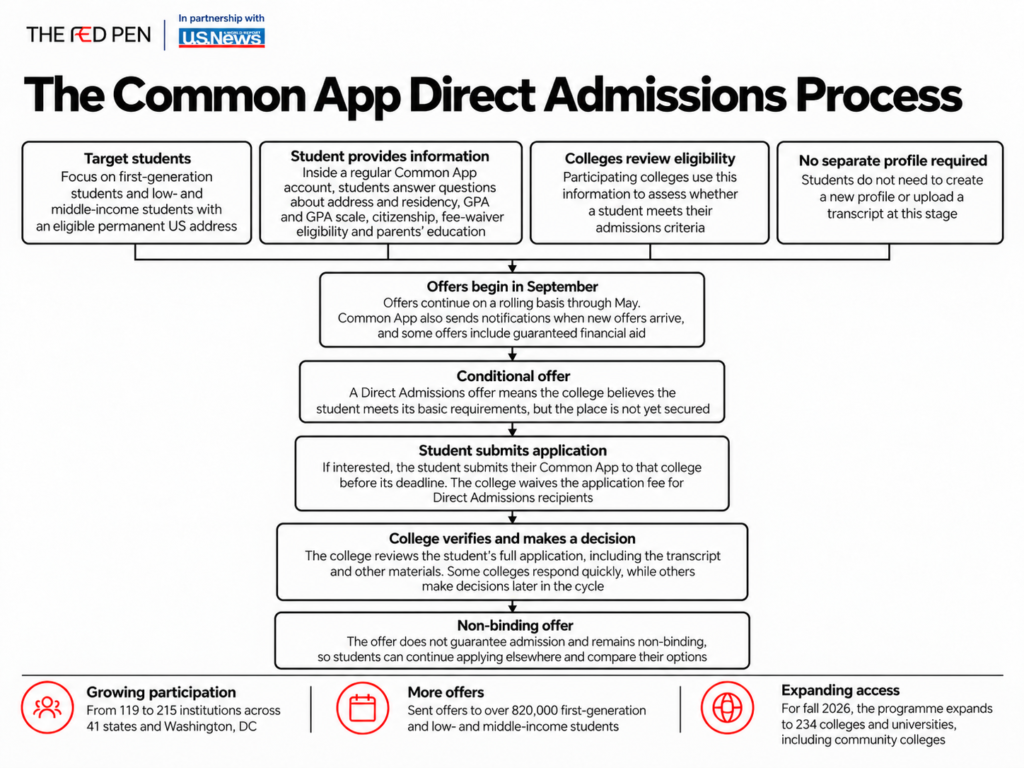
Millions of students already use the Common App platform. The same organisation also runs Common App Direct Admissions. The programme focuses on first-generation students and students from low- and middle-income families with an eligible permanent US address.
First, the process begins inside a regular Common App account. Students answer questions about their address and residency, GPA and GPA scale, citizenship and fee-waiver eligibility. They also provide their parents’ highest level of education. Participating colleges then use this information to assess whether a student meets their admissions criteria. Therefore, students do not need to build a separate profile or upload a transcript at this stage.
Next, offers begin in September and continue on a rolling basis through May. As a result, students should check the Direct Admissions section of their Common App account regularly. Common App also sends notifications when new offers arrive, and some offers include guaranteed financial aid.
However, a Direct Admissions offer is conditional. It means the college believes the student meets its basic requirements, but the place is not yet officially secured. To proceed, the student submits their Common App to that college before its deadline. The college waives the application fee for Direct Admissions recipients. The college then verifies the information against the student’s transcript and other materials. After that, it sends an official admission notice. Some colleges respond quickly, while others make decisions later in the cycle. Every offer remains non-binding, so students can continue applying elsewhere and compare their options before deciding.
Meanwhile, the programme is growing quickly. In its third year as a full-scale programme, Common App Direct Admissions grew from 119 to 215 participating institutions across 41 states and Washington, DC. It also sent offers to more than 820,000 first-generation and low- and middle-income students.
Common App reports that 40 percent of students who received offers expanded their college list. They added at least one institution they had not previously considered. In addition, 25 percent applied to at least one offering institution they had not considered before. For fall 2026, the programme expands to 234 colleges and universities, including community colleges.
How U.S. News Direct Admissions Works
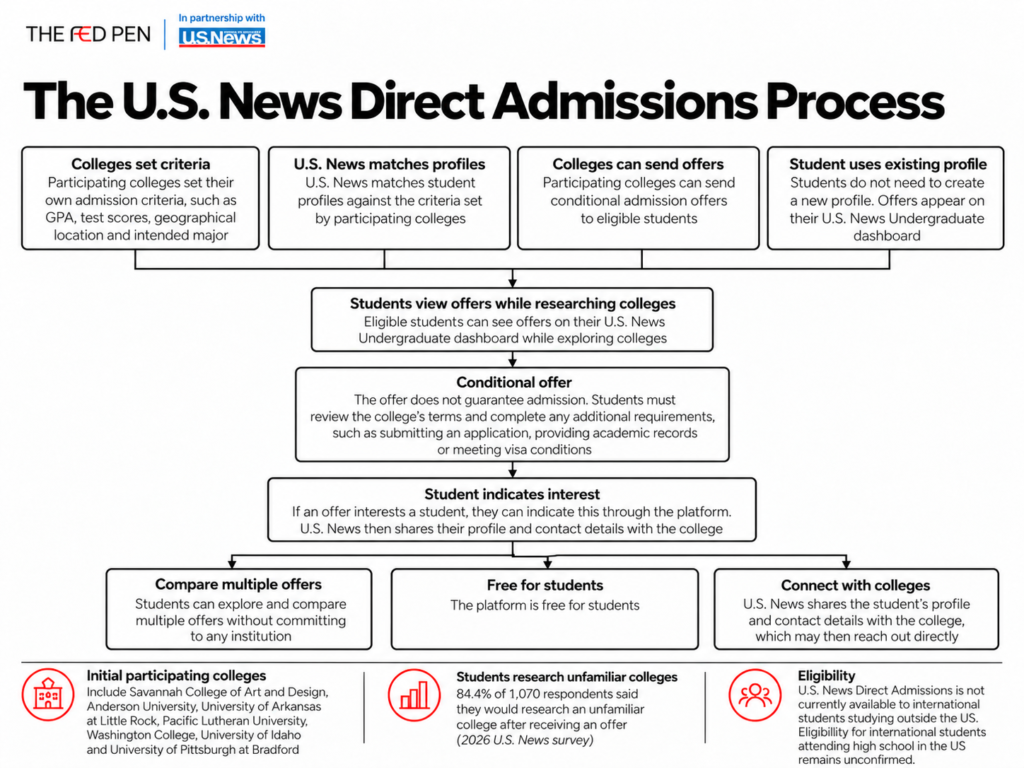
U.S. News Direct Admissions offers another way to receive US college offers without applying through the traditional process. Participating colleges can send conditional admission offers to eligible students.
Currently, U.S. News Direct Admissions is not available to international students studying outside the US. However, eligibility may differ for international students already living in the US and attending an American high school. U.S. News has not yet confirmed the conditions for these students.
First, colleges set their own admission criteria. These may include high school GPA, standardised test scores, geographical location and intended major. U.S. News then matches student profiles against these requirements.
Next, eligible students can view these offers while researching colleges. However, these offers do not guarantee admission. Students must review each institution’s terms and complete any additional requirements. These may include submitting an application, providing academic records or meeting visa conditions.
If an offer interests a student, they can indicate this through the platform. U.S. News then shares their profile and contact details with the college. Students can also compare multiple offers without committing to any institution. The platform is free for students, and offers appear on their U.S. News Undergraduate dashboard.
According to the official launch announcement, the initial participating institutions include Savannah College of Art and Design, Anderson University, University of Arkansas at Little Rock, Pacific Lutheran University, Washington College, University of Idaho and University of Pittsburgh at Bradford.
Furthermore, a 2026 U.S. News survey of 1,070 respondents found that 84.4 percent would research an unfamiliar college after receiving an offer. However, 29.4 percent initially reacted with scepticism and questioned whether such offers were legitimate. Therefore, students should verify unfamiliar offers before proceeding.
Comparing Match, Common App and U.S. News Direct Admissions
All three routes can lead to US college offers without applying through the traditional process. However, they differ in who can use them, what information students provide and what an offer means. Therefore, the table below compares the three routes.
| Criteria | Match | Common App Direct Admissions | U.S. News Direct Admissions |
| Who it is for | Current high school students, including international students through participating schools and school groups | Students with an eligible permanent US address, with a focus on first-generation and low- and middle-income students | Eligible high school students whose profiles meet participating colleges’ criteria. International students studying outside the US are not currently eligible. Eligibility for international students attending high school in the US remains unconfirmed. |
| What you provide | A Match profile covering academic qualifications, interests and preferences, plus a transcript. A counsellor or education adviser may review or certify the profile, depending on the school’s arrangement. | Basic information in your Common App account, including education, GPA, citizenship or residency details, fee-waiver eligibility and parents’ education | Student-profile information that participating colleges use to assess eligibility. Colleges can set criteria such as GPA thresholds, test scores, geographic region and intended major. |
| How colleges see you | Colleges review an anonymised profile against their criteria | Colleges match your Common App responses against their criteria | Participating colleges identify potential matches between their admission criteria and student profiles while students research colleges on U.S. News. |
| When offers arrive | Universities send offers monthly, often within weeks of your profile becoming available | Offers begin in early September and continue throughout the academic year. Timing varies by college and student | Offers may appear while students are researching colleges on U.S. News. Timing depends on the participating college and its admissions campaign. |
| Where you check | Your Match account | The Direct Admissions section of your Common App account. You also receive an email notification | On the U.S. News Undergraduate dashboard, students can review offers while researching participating colleges. |
| What an offer means | An official but non-binding offer, often with scholarship information | A conditional offer. It becomes official after you apply and the college verifies your records | A conditional offer from a participating college. Students must review the college’s terms and complete any required next steps before the college confirms final admission. The offer does not itself guarantee financial aid or visa eligibility. |
Pros and Cons of Match, Common App and U.S. News Direct Admissions
US college offers without applying can reduce uncertainty and broaden a student’s options. However, these alternative admissions routes also have limitations. The table below outlines their key advantages and drawbacks.
| Pros | Cons |
| Greater choice and reassurance: Students may receive offers from universities they had not previously considered. | Limited university participation: Highly selective institutions generally do not participate in these programmes. |
| Reduced application effort and costs: Some routes eliminate initial application requirements or waive application fees. | Eligibility restrictions: Residency, academic and school participation requirements can limit access. |
| Potential financial benefits: Some offers include scholarships or financial aid, helping students assess affordability. | Offers may not meet student expectations: Programmes, costs, locations and admission conditions may not align with student priorities. In fact, a 2026 U.S. News survey found that 91 percent of respondents wanted certainty about their intended major or clear entry requirements. |
What Match, Common App and U.S. News Direct Admissions mean for students in India
For students in India, access to US college offers without applying depends on each platform’s eligibility rules. Global Match works with participating international schools and school groups. Meanwhile, Common App Direct Admissions requires an eligible permanent US address. Participating colleges may also set additional conditions.
However, U.S. News has confirmed that its Direct Admissions programme is not currently open to international students studying outside the US. There may be exceptions for international students already living in the US and attending an American high school, although the eligibility conditions remain unclear.
Students who do not receive offers can still apply through the regular Common App or other traditional routes. As a result, these platforms should complement, rather than replace, a broader admissions strategy.
If you are considering US undergraduate applications, contact The Red Pen’s Undergraduate Admissions team. Our experts can help you identify suitable alternative admissions routes and assess how they fit into your wider US undergraduate admissions strategy. You can also read our latest blogs: 12 Challenging Global Competitions for High School Students and Study in Ireland: A Complete Guide for International Students.